Meal tickets in Romania are one of the most common employee benefits, but employers need to understand their tax treatment, payroll impact and practical rules before including them in a compensation package.
For many Romanian employees, meal tickets are a familiar part of monthly income. For employers, especially foreign companies hiring in Romania for the first time, they can be a useful way to improve the employee package without simply increasing gross salary. However, meal tickets are not just an HR benefit. They also have payroll, tax and documentation implications.
This article explains what meal tickets are, how they are generally taxed, what employers should check before granting them, and why the payroll treatment should be reviewed carefully.
What are meal tickets in Romania?
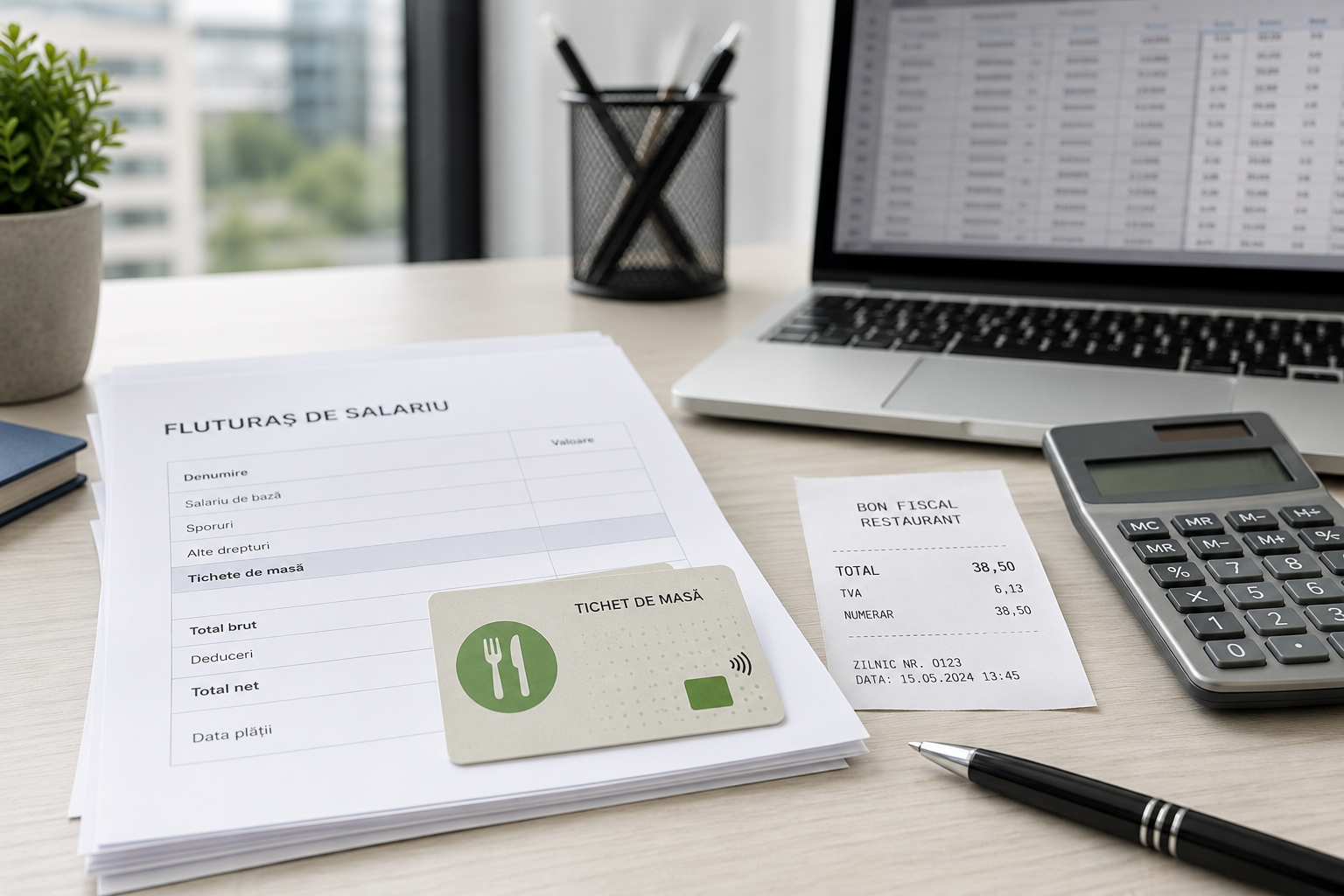
Meal tickets are value tickets granted by employers to employees, mainly to help cover food and meal-related expenses. In practice, they are often issued electronically, through a card provided by a specialized issuer, and can be used in restaurants, supermarkets and other accepted merchants.
The employer is not required to grant meal tickets by default. They are usually offered as an extra-salary benefit, based on the employer’s internal compensation policy, employment documentation, collective bargaining arrangements where applicable, and payroll setup.
A key point is that meal tickets are normally linked to working days. Employers should not treat them as a fixed monthly cash bonus. The number of meal tickets granted should generally reflect the number of days for which the employee is eligible under the applicable rules and the company’s internal policy.
For example, if an employee worked 20 eligible days in a month and the company grants meal tickets at a certain daily value, the payroll team should calculate the benefit based on those eligible days, not automatically on a full calendar month.
Why meal tickets in Romania matter for employers
Meal tickets can look simple from an HR perspective, but they matter for tax compliance because they are processed through payroll and affect the employee’s monthly tax position.
For employers, the main reasons to review meal tickets carefully are:
- they are a recurring monthly benefit;
- they must be calculated based on eligibility and working days;
- their tax treatment has changed over time;
- they may affect payroll declarations and payslip presentation;
- they should be supported by clear internal documentation.
This is especially important for foreign employers that are used to different benefit systems in other countries. A benefit that is tax-free or treated outside payroll in another jurisdiction may need specific reporting in Romania.
Meal tickets are also relevant for budgeting. The gross cost for the employer, the nominal value granted to the employee and the net benefit perceived by the employee are not always the same thing once income tax and health insurance contribution treatment are considered.
Tax treatment of meal tickets in Romania
As a general rule, meal tickets are treated as salary-related benefits for Romanian payroll purposes. They are not simply informal allowances.
Currently, meal tickets are generally subject to:
- 10% income tax, and
- 10% health insurance contribution, known as CASS.
They are generally not subject to the standard pension contribution, known as CAS, and they are not treated in the same way as ordinary gross salary for all contribution purposes. However, employers should always check the current payroll rules before implementation, because Romanian tax rules for benefits can change.
This distinction is important. A normal salary increase is usually subject to the full salary tax and social contribution burden. Meal tickets, by contrast, may still be more efficient than increasing gross salary, but they are no longer as lightly taxed as they were in previous years.
Since January 2024, the value of meal and holiday vouchers has been included in the base for the Romanian health insurance contribution. This is one of the reasons why older articles about meal tickets may now be misleading if they still describe the benefit as subject only to income tax.
Meal tickets in Romania and the maximum daily value
Meal tickets are subject to a maximum nominal value per eligible working day. Employers should check the current legal ceiling before implementing or updating the benefit, because the maximum value can change over time.
The maximum value is a ceiling, not an obligation. An employer may decide to grant meal tickets below the maximum amount, depending on budget, internal policy and compensation structure.
For example, if the legal maximum value is RON 45 per working day, an employer could decide to grant RON 45 per eligible working day, a lower amount such as RON 35 per eligible working day, or no meal tickets at all if the benefit is not part of the company’s policy.
The important point is consistency. Employers should define the benefit clearly and apply it in line with the legal framework and their internal employment documentation.
Payroll reporting for meal tickets in Romania
Meal tickets should be reflected correctly in the payroll process. The payroll provider or internal payroll team should know who is eligible, the daily value granted, the number of eligible days, whether absences affect eligibility, how tax and CASS should be calculated, and how the amounts should appear in payroll reports and declarations.
In practice, this means meal tickets should be included in the monthly payroll review, not handled separately as a purely administrative HR item.
For foreign companies, this can be a common source of confusion. The HR team may approve the benefit, the finance team may budget the cost, and the payroll provider may calculate the tax treatment. If these teams do not coordinate, errors can appear in monthly reporting.
A simple monthly payroll checklist can help. Before payroll is finalized, the employer should confirm the list of employees receiving meal tickets, the eligible days, the value per ticket, and any changes caused by new hires, leavers, unpaid leave or other absences.
Example: how meal tickets in Romania affect the employee
Let’s take a simplified example.
An employee receives meal tickets with a nominal value of RON 45 per eligible working day. In a month with 20 eligible working days, the nominal value of the benefit is:
20 days x RON 45 = RON 900
If the benefit is subject to 10% income tax and 10% CASS, the payroll impact should be calculated accordingly. In simplified terms, the employee may not experience the full RON 900 as a net economic benefit after payroll taxation.
This is why employers should explain the benefit carefully. Employees often think of meal tickets based on their face value, while payroll teams must account for the applicable tax and contribution treatment.
The exact calculation should be handled by the payroll provider based on the current rules and the employee’s monthly payroll data.
Common employer mistakes with meal tickets
One common mistake is treating meal tickets as an automatic monthly amount, without reconciling them with working days or eligibility.
Another mistake is relying on outdated tax treatment. Before 2024, meal tickets were commonly described as subject to income tax but not social contributions. Since the inclusion of meal vouchers in the CASS base, employers should be careful with older guidance, old payroll setups and copied HR policies.
A third mistake is failing to document the benefit properly. Meal tickets should be supported by clear internal rules, employment documentation where needed, and payroll records. This is especially important when the company wants to show that the benefit was granted consistently and in accordance with the law.
A fourth mistake is not explaining the difference between meal tickets and cash salary. Meal tickets have a specific legal and tax regime. They are not the same as a meal allowance paid freely in cash, and they should not be described casually in employee communications as if they were ordinary net salary.
How foreign companies should approach meal tickets in Romania
Foreign companies hiring employees in Romania should review meal tickets as part of the full employment cost package.
The review should answer several practical questions: will the company grant meal tickets to all employees or only to certain categories, what daily value will be granted, how eligibility will be tracked, who will provide the meal ticket cards or electronic vouchers, how the benefit will be reflected in payroll, how employees will be informed about the tax treatment, and whether the benefit aligns with the company’s broader compensation policy.
This review is useful before the first Romanian employee is hired, not after payroll has already started. It is much easier to configure payroll correctly from the beginning than to correct several months of inconsistent treatment later.
Meal tickets can also be compared with other benefits, such as private health insurance, pension contributions, gift vouchers, transport support or remote work allowances. Each benefit may have a different tax treatment, so employers should avoid assuming that all employee benefits in Romania follow the same rules.
Are meal tickets still attractive for employers?
Yes, meal tickets can still be attractive, but the value should be assessed realistically.
They remain popular because they are familiar to employees, relatively easy to administer through specialized issuers, and linked to a clear everyday need. They can also help employers offer a more competitive package in a way that employees recognize immediately.
However, they are not completely tax-free. The current treatment means employers should model the cost and employee value properly.
For many employers, meal tickets work best as part of a balanced benefits package. They may not replace salary increases, but they can support employee retention and make the overall package more attractive.
Practical checklist before granting meal tickets in Romania
Before introducing meal tickets, employers should check the current maximum nominal value per working day, whether the company’s internal policy allows the benefit, whether employment contracts or internal regulations should mention the benefit, the employee categories that will receive it, the payroll treatment for income tax and CASS, how absences, new hires and leavers affect eligibility, how the benefit will be shown on payslips, and whether the payroll provider has updated its treatment for the latest rules.
This checklist is particularly important for companies that manage Romanian payroll from outside Romania. A global payroll template may not be enough. Local rules should be reviewed before implementation.
Conclusion
Meal tickets are a practical and widely used employee benefit in Romania, but they should not be treated as a simple administrative add-on.
Employers need to understand the daily value rules, payroll reporting requirements, income tax treatment and CASS implications. They should also make sure the benefit is documented clearly and applied consistently.
For foreign companies, meal tickets can be a useful part of a Romanian compensation package, but the setup should be reviewed together with payroll and tax advisors before implementation. A careful review can help avoid payroll errors, employee confusion and unnecessary compliance risks.